TEMPO.CO, Jakarta - Various posts circulating on TikTok and Instagram [archive] claim that the Indonesian government no longer relies on or uses the US dollar. These posts have been circulating amid the weakening of the rupiah against the US dollar, which briefly reached Rp18,049 on Thursday, June 4, 2026.
Claims that Indonesia is moving away from the US dollar emerged after Finance Minister Purbaya Yudhi Sadewa announced the Panda Bond, a debt instrument or bond denominated in yuan or Renminbi (RMB). This strategy is believed to be a step toward moving away from the US dollar and strengthening the rupiah.
Is it true that Indonesia has abandoned the US dollar as a strategy to strengthen the rupiah?

FACT CHECK
Tempo verified the content using reverse image searches, interviews, and articles from other credible sources. The findings show that the Panda Bond was issued with the aim of diversifying financing, not to completely abandon the US dollar. Bank Indonesia also continues to use the US dollar for foreign exchange reserves and global transactions.
The Circulating Video Is Not an Announcement of Abandoning the US Dollar
The post originated from Antara’s X account when Finance Minister Purbaya announced the issuance of the Panda Bond agreement during a press conference on Tuesday, May 5, 2026. In the video, Purbaya stated that Indonesia’s economic growth reached 5.61 percent and showed strong acceleration amid global market dynamics.
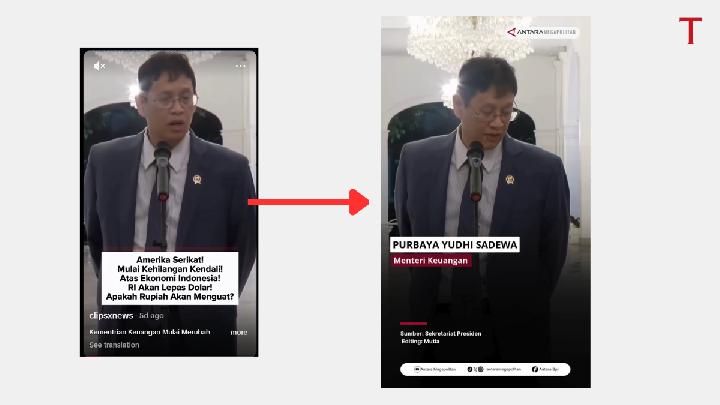
Additionally, other videos were taken from Purbaya’s TikTok account (this one and this one). The videos show Purbaya participating in a communal iftar event in March 2026 and the APBN KiTa press conference in May 2026.

However, these videos were used to spread misinformation regarding the discontinuation of the US dollar. In fact, none of the videos cited contained any statement by Purbaya regarding a decision to abandon the dollar.
Panda Bonds Are Not Intended to Discontinue the Use of the US Dollar
Purbaya announced that the Ministry of Finance (MoF) is ready to issue Panda Bonds. He plans to market these Indonesian bonds to Chinese investors in mid-June 2026.
The plan to issue debt securities—or bonds—denominated in currencies other than the US dollar is part of an effort to diversify financing. Deni Surjantoro, Head of the Ministry of Finance’s Communications and Information Services Bureau, stated that the decision to issue Panda Bonds should not be interpreted as a complete cessation of US dollar use.
“No, it cannot be interpreted that way. Panda Bonds diversify the supply of foreign currency in Indonesia,” Deni said when contacted by Tempo on Sunday, June 7, 2026.
In a previous Tempo report, Suminto, Director General of Financing and Risk Management (DJPPR) at the Ministry of Finance, stated that the government has not yet been able to confirm the size or nominal target of the yuan-denominated bonds to be issued.
“We’ll assess the issuance first; after all, this is the first-ever issuance. So we’ll see what the market appetite is like,” said Suminto at his office in Jakarta on Friday, June 5, 2026.
He also confirmed Purbaya’s plan to meet with investors in the UK to secure capital for bonds denominated in US dollars and euros. “All the major investors are in London, and we do hold regular investor updates there,” he said.
BI Still Uses the US Dollar
Bank Indonesia (BI) has never completely stopped using the US dollar. In an effort to maintain the stability of the rupiah’s exchange rate, BI has imposed restrictions on foreign exchange transactions.
Based on Bank Indonesia Governor’s Regulation No. 11 of 2026, the central bank has established foreign exchange market transaction policies through specific threshold adjustments for cash transactions involving the purchase of foreign currency against the rupiah.
Moreover, BI still uses the US dollar for global transactions and foreign exchange reserves. According to a report from the Ministry of Finance, Indonesia’s foreign exchange reserves stood at US$148.2 billion as of the end of March 2026.
Bank Indonesia data shows that Indonesia’s trade balance is still denominated in US dollars. Indonesia’s trade balance in April 2026 recorded a surplus of US$0.09 billion, following the previous month’s surplus of US$3.32 billion.
The US dollar remains the benchmark currency for international transactions. Historically, the use of the US dollar began with the Bretton Woods Agreement, signed in July 1944 in New Hampshire, USA. Following World War II, representatives from 44 Allied nations at the United Nations Monetary and Financial Conference agreed on a new global monetary system.
That agreement also laid the groundwork for the establishment of the International Monetary Fund (IMF) and the World Bank. Delegations from 44 countries agreed to use the US dollar as the exchange rate for their currencies. To this day, America’s economic dominance has made the US dollar the benchmark for international transactions.
CONCLUSION
The narrative claiming that Indonesia has abandoned the US dollar as a strategy to strengthen the rupiah is false.
TEMPO FACT CHECK TEAM
**Do you have information or claims that you want to have fact-checked? Contact our ChatBot. You can also send criticism, objections, or feedback for this Fact-Checking article via email to [email protected].






























:strip_icc():format(jpeg):watermark(kly-media-production/assets/images/watermarks/bola/watermark-color-landscape-new.png,1125,20,0)/kly-media-production/medias/5495647/original/074499000_1770385031-barba.jpeg)