TEMPO.CO, Jakarta - Within a week, two individuals of conservation elephants died in the Tesso Nilo National Park, Ukui Sub-district, Pelalawan Regency, Riau, and the Way Kambas National Park, Lampung, Indonesia. The elephants were Indro, who died on Monday, June 29, 2026, around 03:45 AM WIB (Western Indonesian Time) in Tesso Nilo, and Indra, who died on Monday, June 22, 2026, at 11:06 AM WIB in Way Kambas.
Indro, a male elephant, died at the age of 45. The elephant, nicknamed Captain Indro, died after receiving intensive medical treatment by the joint team of the Riau Natural Resources Conservation Agency and the Tesso Nilo National Park (TNNT). The cause of death was health complications triggered by a decreased appetite post-musth phase (the peak period of hormonal/aggressive behavior in male elephants), as stated by the Tesso Nilo National Park on Tuesday, June 30, 2026.
Indro is known for his role in mitigating human and animal conflicts in Tesso Nilo. Here is the chronology of Indro's death as reported by the Tesso Nilo National Park:
April 25-May 6, 2026
Musth phase initiated. Indro was observed entering the early stage of musth on April 25, 2026. During this phase, his behavior became more aggressive starting from May 1, 2026, which was marked by the secretion of sperm from his genitals.
May 6, 2026
Secretion from the musth gland located on the temple area began to appear moist.
June 3-5, 2026
Increased aggression. By early June, at the safety tethering site, Indro became unapproachable, did not respond to the mahouts' commands, and started displaying behaviors that endangered the safety of the personnel. To maintain his physical condition, the flying squad team provided food such as banana stems, coconut leaves, and elephant grass, and ensured the availability of drinking water every morning and evening from a safe distance.
June 5, 2026
Rim also started bathing Indro using a water pump to maintain his hygiene and body temperature stability.
June 24, 2026
Medical sedation. Due to the prolonged musth phase, the TNNT medical team coordinated with the Riau BKSDA to perform sedation to install additional chains as a safety measure. Post-procedure, the medical team administered an antidote until Indro fully regained consciousness and stood stable.
June 25-26, 2026
Decreased appetite. Starting from the afternoon after the sedation, Indro was observed to drastically lose his appetite and drink. The medical team from TNNT immediately conducted intensive monitoring for 24 hours and closely coordinated with expert veterinarians for further treatment.
June 27-28, 2026
Critical action and infusion therapy. The medical team injected 100 ml of Biodin (energy supplement), manually evacuated feces, checked body temperature, and administered supportive infusions of 5 bottles in the evening and 5 bottles at night, as there was no significant improvement.
June 28, 2026
Indro showed hopeful signs after he began drinking water and trying to eat. To expedite his physical recovery due to the decreased appetite, the medical team administered 60 bottles of infusions. In the evening, Indro was bathed, drank willingly, and his body temperature was normal. Even towards his death, he remained actively interested in food.
June 29, 2026
Indro's death. A sudden change in his condition occurred in the early hours at 03:30 AM. Indro was found lying down. The veterinary doctor and the mahout team immediately conducted emergency checks on his respiratory function and performed cardiopulmonary resuscitation (CPR) for several minutes. However, Indro did not respond and was officially pronounced dead at 03:45 AM.
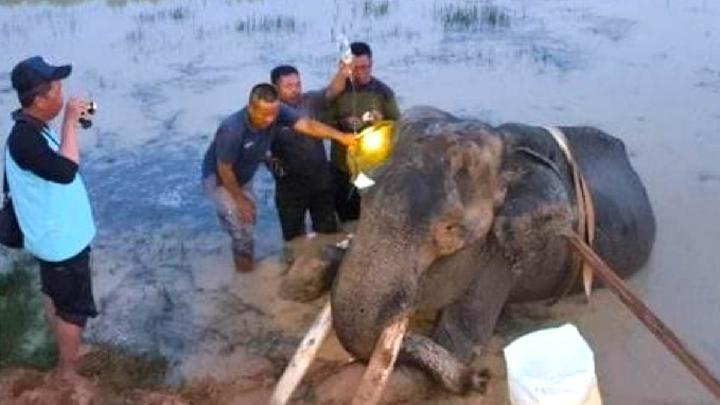 An elephant named Indra before his death at Way Kambas National Park. Documentation of the Ministry of Forestry's Public Relations
The Head of the Way Kambas National Park, MHD. Zaidi, stated that Indra was a gentle 42-year-old male elephant whose passing comes after more than three decades of being a crucial part of the Sumatran elephant (Elephas maximus sumatranus) conservation efforts in Lampung Province. He emphasized that the departure of Indra is a significant loss for Indonesian conservation.
"Indra was not just an animal under our care, but a part of the long history of Sumatran elephant conservation in Way Kambas. His dedication in various field activities and handling of conflicts involving wildlife has made a real contribution. We express our highest respect for Indra's dedication throughout his life," said Zaidi.
Indra originated from the Karang Sari Village, East Lampung Regency, and joined the Way Kambas Elephant Training Center (PLG), TNWK, in 1995. According to Zaidi, known for his strength, resilience, and bravery, Indra has been involved in various crucial field operations, ranging from wild elephant evacuations, area protection patrols, to wild animal-human conflict mitigation in various areas of Lampung. "This dedication has earned him utmost respect from the mahouts, veterinarians, animal keepers, and conservation activists," said Zaidi.
Indra's declining health stemmed from an incident at the end of 2017. Zaidi mentioned that after assisting in wildlife conflict resolution in the Bukit Barisan Selatan National Park (TNBBS) area, the vehicle carrying Indra was involved in a traffic accident.
"The incident resulted in serious physical trauma, where medical examinations suspected that Indra experienced a disruption in the vertebral bone segment (suspect ruptured os vertebrae) which gradually affected his mobility and health," he said.
Following the injury, Zaidi said Indra was retired from field duties. The TNWK veterinary team and animal keepers provided intensive care, therapy, and daily monitoring to maintain his quality of life. However, his physical condition continued to deteriorate with age.
On Sunday, June 21, 2026, Indra was engaging in the regular bathing activity in the swamp area. According to Zaidi, when being directed to return to the enclosure, Indra suddenly collapsed on the swamp slope and was unable to stand. An emergency effort was immediately made by the accompanying mahout, Siswo, together with the rescue team and the assistance of other trained elephants. "Although successfully positioned to sit for a few minutes, his very weak physical condition made Indra collapse again," said Zaidi.
Considering the limited swamp terrain and the animal's physical condition, which made it impossible to evacuate to the main medical facility, the TNWK veterinary team immediately conducted intensive emergency rescue at the scene. After struggling for more than 20 hours to maintain his vital signs, Indra was finally pronounced dead on Monday, June 22, 2026, at 11:06 AM WIB (Western Indonesian Time).
As part of the standard medical operational procedures and scientific accountability, a necropsy was performed three hours after death. "This carcass dissection process was led by drh. Diah Esty Nggraeni (PLG TNWK) and drh. Atma (Sumatran Rhino Sanctuary), supported by five animal health workers from the TNWK Elephant Hospital," said Zaidi.
Zaidi mentioned that to maintain transparency, the necropsy process was conducted under the supervision and directly witnessed by the East Lampung Police, East Lampung Military District 0429, and the Forestry Police of TNWK. Several organ samples were taken for further laboratory analysis to obtain comprehensive data on the clinical factors contributing to the death.
"Following the completion of all examinations, the carcass of Indra was immediately buried in a specific location within the TNWK area," he said.
Read: Indonesia Bans Elephant Riding at Tourist Attractions
Click here to get the latest news updates from Tempo on Google News